

Although a layoff decision is often termed as a “right-sizing” strategy reflecting the general perception about its normality, especially during an economic downturn, previous research concluded that entrepreneurs did not always consider layoff as a morally acceptable decision given its negative impacts on the society such as decreasing consumption, economic contraction, and mental health of the layoff victims. Hence, entrepreneurs selected different strategies to survive their businesses such as wage reduction or working time reduction. Given its negative impacts, it is important to understand the factors that prevent a layoff decision.
Proximity and moral judgment of a layoff decision.
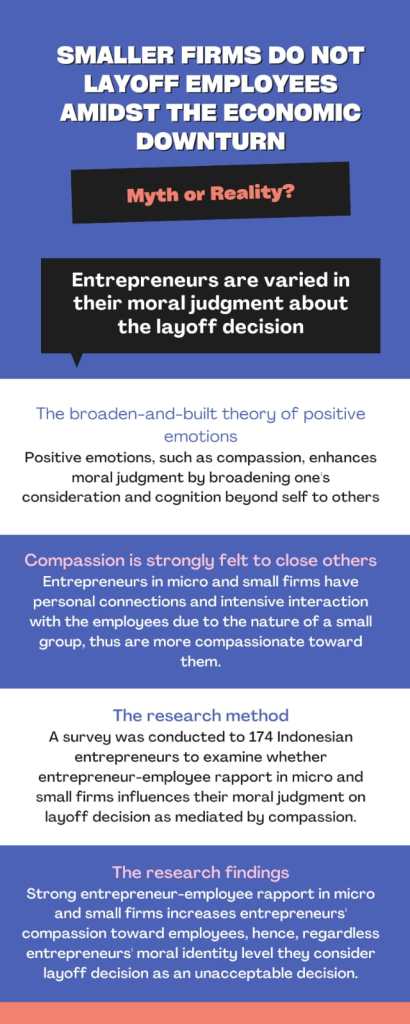
Moral judgment increases when there is a high degree of proximity between individuals involved in the decision. However, proximity between the entrepreneurs and the employees is more likely to be developed in a small organization setting rather than in a large setting with a bigger number of employees. In a small setting, entrepreneurs and employees can have intensive interaction and communication that promote rapport between organization members. The proximity between individuals can also promote compassion, a positive emotion that represents one’s psychological response upon seeing others suffering that prevents individuals from performing behaviours that can harm others and immoral behaviours. Compassion is strongly felt to close than distant others. Consistently, the broaden-and-built theory of positive emotions posits that positive emotions can broaden an individual’s thoughts and cognition. When entrepreneurs feel strong compassion for their employees, it is expected that they will consider the negative consequences of a layoff on their employees and prevent the decision. In addition, this study examines whether the indirect relationship between entrepreneur-employee rapport and moral judgment on a layoff decision as mediated by compassion fluctuates according to the entrepreneur’s moral identity level, the degree to which being a moral individual is an important self-defining aspect.
The dominant influence of contextual aspect on layoff decision.
A survey was conducted in Indonesia by recruiting 174 Indonesian entrepreneurs to participate in the study using an online platform. Indonesia was selected as a context due to the absence of the government financial support that prevents layoff, such as job-keeper support in Australia. Therefore, the decision to layoff is more of a personal decision.
Interestingly, the statistics show that micro and small businesses in Indonesia performed fewer layoffs (33.23 %) although they were impacted more severely than the big businesses (46.64 %). This study found that micro and small business entrepreneurs in Indonesia generally scored high in rapport (M=6.27) and compassion (M=6.06). Subsequently, entrepreneurs tend to consider a layoff decision as an unacceptable decision when they established a strong rapport with their employees as they feel stronger compassion toward them regardless the degree of the entrepreneur’s moral identity.
Growing compassionate entrepreneurs as a strategy to prevent layoffs.
Growing compassionate entrepreneurs becomes an essential strategy to prevent layoffs in micro and small businesses. As micro and small business entrepreneurs generally consider layoff as an unacceptable, government support is increasingly important to help them to prevent layoffs such as by providing a job keeper support or to educate them with several alternative strategies that allow them to minimize the operating cost without having to layoff their employees such as by reducing wage temporarily, reducing work hours, changing salary structure, amongst others. Government or NGOs can utilize social marketing campaigns highlighting the actual negative impacts of the economic crisis on employees’ well-being. Such exposure to suffering others can also activate compassion that is strongly felt for close others than distant others. Besides, the social campaign may also showcase the potential negative impacts of a layoff decision on the employees.
Authors Bio
Widya Paramita is a lecturer as well as a researcher at the Department of Management, Faculty of Economics and Business, Universitas Gadjah Mada, Indonesia. She holds a Ph.D degree in marketing from the University of New South Wales, Australia. She has a strong interest in entrepreneurship research and currently is the Head of the Entrepreneurship Research Group in the Management Department, Universitas Gadjah Mada.
Boyke Rudy Purnomo is a Senior Lecturer at the Department of Management, Faculty of Economics and Business, Universitas Gadjah Mada, Indonesia. He earned his Ph.D from the University of Agder, Norway. His research interest is in entrepreneurship, SMEs, and entrepreneurial finance. His writings examine the intersection between innovation, creative industries, and entrepreneurship.
Risa Virgosita is a lecturer at the Department of Management, Faculty of Business and Economics, Universitas Gadjah Mada. She holds a Ph.D degree from the University of Agder, Norway. Her research interests are entrepreneurship, SMEs, and family business.
Amin Wibowo is a lecturer and researcher at the Department of Management, Faculty of Economics and Business, Universitas Gadjah Mada. He holds a Ph.D degree from Curtin University of Technology, Australia. His research interests are human resources management and strategic management from a behavioral perspective.


Leave a Reply