

As the war in Ukraine stretches into 2025, countless of Ukrainian refugees remain in reception and housing centres across Europe. For the local governments accommodating these communities, the challenge is no longer about providing emergency relief—it’s about finding ways to offer long-term support.
In our recent study published in the Journal of Business Venturing Insights, we respond to a local government organization which sought to do just that. Sanctuary Ukraine (SU), a reception and housing initiative for Ukrainian refugees, adopted social entrepreneurship practices to augment its traditional social work—an innovative move intended to overcome the scarcity of resources and opportunities that public sector organizations have long struggled with. As an indicator of its impact, nearly 80 % of SU’s residents have since found employment. However, we also see emergent problems that threaten the well-being of the refugee residents.
Translating academic insights into actionable recommendations
We translate academic insights into actionable recommendations to help prevent and alleviate the three problems we found and support local governments that seek to empower Ukrainian refugees through social entrepreneurship practices.
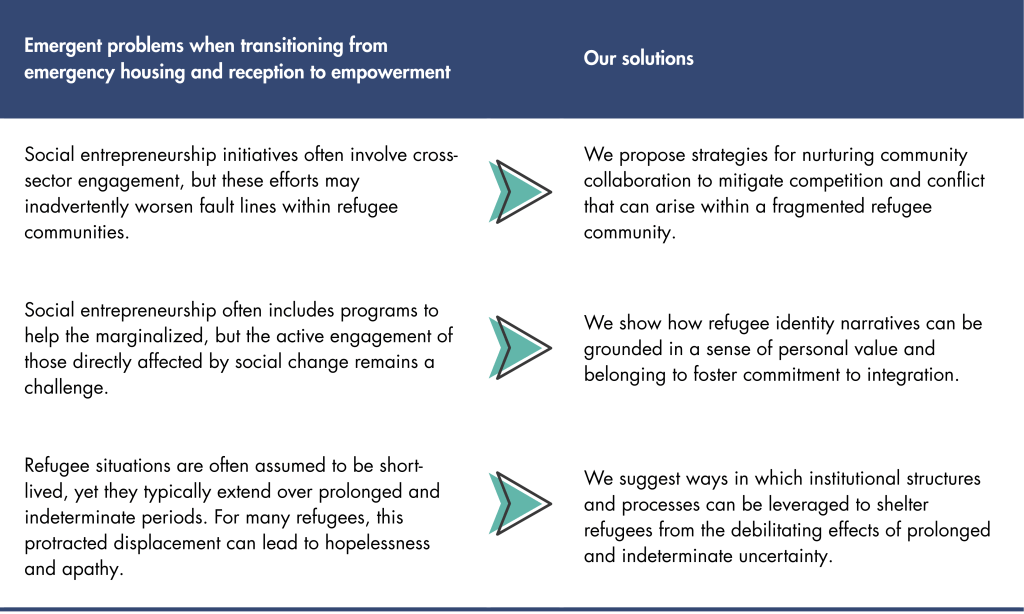
Three ways to use this paper:
We see three functions of our paper which may help SU and similar organizations:
- A diagnostic tool—we offer a framework to help understand sources of conflict within refugee communities, why commitment to integration might remain low despite best efforts, and why feelings of aimlessness and indifference endure despite improved living conditions.
- A toolbox to design and implement solutions—we provide practical, evidence-based recommendations for adopting social entrepreneurship practices. These practices can help strengthen community collaboration, restore a sense of value and belonging, and foster feelings of tangible progress and growth despite prolonged uncertainty.
- A validation of your work—If you’re already incorporating social entrepreneurship practices, bring this paper to policymakers and use it to help explain how your efforts may support integration, well-being, and long-term empowerment.
Who should read the full paper?
This study will be especially useful for:
- Managers of reception and housing centres for Ukrainian refugees.
- Policymakers considering social entrepreneurship practices.
- Researchers interested in (social) entrepreneurship, translocational identity, and institutional sheltering approaches in refugee contexts.
Read the full article here: From emergency relief to empowerment: Transitioning government-led social entrepreneurship practices to support Ukrainian refugees.
Author Bios
Mark van der Giessen is an Assistant Professor in People Analytics at Aalto University School of Business. His research aims to advance knowledge to better organize and manage workforces in a world increasingly shaped by natural and geopolitical crises. His work explores local responses to refugee crises and the implications of geopolitical conflict as it spills over into contemporary workplaces.
Anastasia Koptsyukh is a Doctoral Candidate in Entrepreneurship at Aalto University School of Business. Her research explores entrepreneurial dynamics in extreme settings and in response to grand societal challenges. She examines how organizations emerge, grow, and create impact through resourcefulness, sustainability, and community-based approaches. She also contributes to governmental policy reports on crisis response and has co-founded and led prosocial and sustainability-focused ventures.
Farah Kodeih is an Associate Professor at IESEG School of Management, Paris. Her research explores how organizations and individuals navigate profound institutional transformations, with a particular focus on contexts marked by repression and exclusion. She examines the challenges of organizing under conditions of democratic backsliding, forced displacement, and sustainability transitions, seeking to better understand how actors adapt to – and contest – restrictive institutional environments.
Sophie Alkhaled is an Associate Professor of Entrepreneurship at Lancaster University Management School. Sophie’s research focuses on the intersectionality of gender, entrepreneurship, empowerment and poverty alleviation, and their collective impact as a catalyst for social change and sustainable development amongst refugee, migrant and marginalised communities, particularly in Middle Eastern contexts.
Anastasiia Poberezhna is a Doctoral Candidate in Conflict Transformation at the Institute of Security and Global Affairs, Leiden University. Her research focuses on feminist methodologies, care ethics, and the dynamics of forced displacement. Specifically, her work examines how experiences of forced migration are shaped by gendered expectations of care within the context of the Russo-Ukrainian war.
Marjolein Wesselius den Boer is an experienced Manager at Sanctuary Ukraine for the Municipality of Lelystad. She is responsible for the accommodation of 400 Ukrainian refugees, overseeing daily operations including facility management, financial control, staff planning, as well as day programs and career guidance for the refugees.


Leave a Reply